From lost satellite parts to shattered rocket fragments, space debris—or space junk—has become one of the biggest threats to humanity’s future in orbit. The growing cloud of debris circling Earth doesn’t just pose a risk to astronauts and satellites, but to the long-term sustainability of space exploration itself. Here are 3 key points to understand the issue—and what we can do to fix it.
Table of Contents
1. What Is Space Debris and Where Did It Come From?
When we look up at the night sky, we usually imagine the vast emptiness of space dotted with stars, planets, and the occasional passing satellite. But Earth’s orbit is not so clean as we might think. Decades of space exploration have left behind a growing cloud of space debris—unwanted, uncontrolled objects circling our planet. This issue, once overlooked, is now considered one of the most pressing challenges for space agencies, private companies, and the future of space travel.
Defining Debris Space
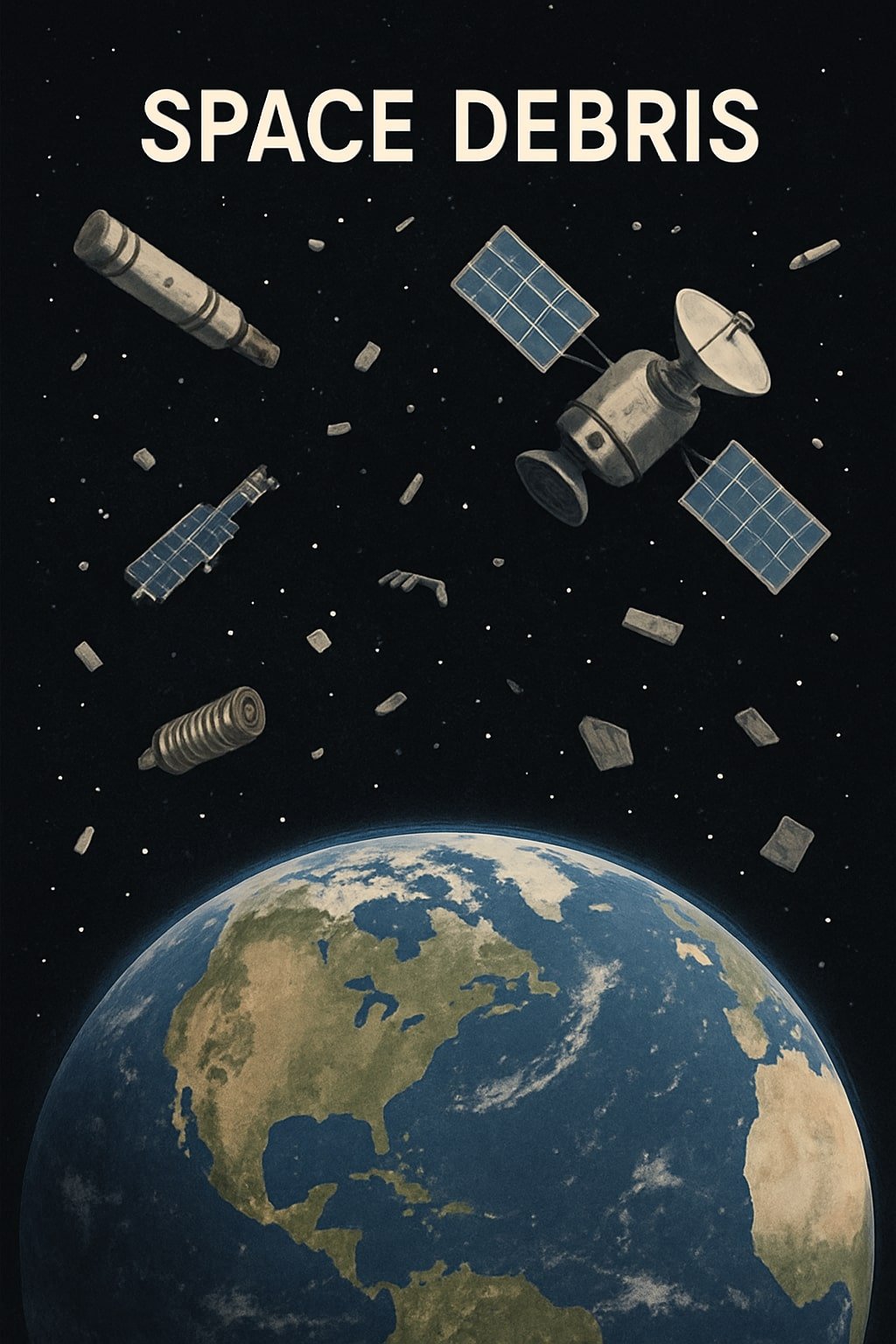
Space debris, also known as orbital debris or space junk, refers to any non-functional human-made object in orbit around Earth. This includes:
- Defunct satellites that no longer serve a purpose.
- Upper stages of rockets left behind after launching spacecraft.
- Tools, bolts, and fragments lost during space missions.
- Shards from explosions or collisions in orbit.
Unlike meteoroids (natural space rocks that orbit the Sun), space debris is entirely artificial and often unpredictable in its movement. Objects can range from entire satellites weighing several tons to flecks of paint no larger than a grain of sand. Surprisingly, even tiny fragments can pose severe risks, since they often travel at speeds exceeding 28,000 km/h (17,500 mph).

The Origins of Space Debris
Early Space Exploration: The very first artificial satellite, Sputnik 1, launched in 1957 by the Soviet Union, marked the beginning of the space age. Although Sputnik itself burned up in the atmosphere only a few months later, the rocket stage that propelled it stayed in orbit for years. This event set the precedent: every launch left something behind.
Defunct Satellites: Thousands of satellites have been launched since the 1950s. Many were designed with no plan for disposal. Once their fuel ran out or their systems failed, they simply remained in orbit, effectively becoming floating space junk.
Rocket Stages and Mission Debris: When rockets deliver payloads to space, their upper stages often remain in orbit. While some fall back to Earth naturally, many linger for decades. Additionally, missions sometimes shed covers, clamps, or even small hand tools—famously, an astronaut once lost a glove during a 1965 spacewalk.
Collisions and Explosions: The biggest contributors to today’s debris problem are accidental collisions and deliberate satellite destruction. Exploding fuel tanks, battery ruptures, and intentional anti-satellite missile tests have generated thousands of high-speed fragments.
- In 2007, China destroyed its Fengyun-1C weather satellite in a missile test, creating more than 3,000 trackable pieces of debris.
- In 2009, an inactive Russian satellite collided with a U.S. communications satellite, adding over 2,000 fragments to orbit.
Fragmentation Over Time: Even small collisions can break debris into smaller and smaller pieces. This cascade effect, known as the Kessler Syndrome, suggests that without intervention, the amount of debris could increase exponentially, making certain orbits unusable for future missions.
Why Space Debris Matters
The dangers of space debris are not hypothetical—they are real and growing:
Long-term sustainability: If orbital paths become too crowded with debris, future space missions, including exploration of the Moon and Mars, could be jeopardized.
Threat to spacecraft: Even a tiny piece of debris can puncture spacecraft walls, damage solar panels, or disable instruments.
Risk to the International Space Station (ISS): Astronauts aboard the ISS regularly perform “debris avoidance maneuvers” to steer clear of dangerous objects.
Impact on satellites: Communications, weather forecasting, GPS, and military satellites are all at risk from debris collisions.
Even the smallest fragments can cause catastrophic damage due to their extremely high speeds (up to 28,000 km/h).
Space Junk Classification
According to the ESA’s 2025 report—summarizing data up to August 2024—the estimated number of space objects in orbit in the different size ranges is the following:
- Larger than 10 cm: approximately 54,000 objects (including approximately 9300 active payloads)
- Between 1 cm and 10 cm: about 1.2 million objects
- Between 1 mm and 1 cm: roughly 130 million objects
These classifications reflect the current understanding of orbital debris distribution as per ESA’s MASTER (Meteoroid and Space Debris Terrestrial Environment Reference) model and Space Debris Office estimates.
| Size Range | ESA Estimated Count | Notes |
|---|---|---|
| > 10 cm | ~54,000 | Trackable; includes defunct satellites, rocket bodies, etc. |
| 1 cm – 10 cm | ~1.2 million | Too small to track individually, yet capable of severe damage |
| 1 mm – 1 cm | ~130 million | Microscopic fragments that remain untracked and still pose threats |
2. Why Space Debris Is Dangerous: The Kessler Syndrome
Space exploration has transformed human civilization. Satellites provide global communication, GPS navigation, weather forecasting, and scientific insights that were unimaginable just a century ago. But with progress comes an unintended consequence: space debris. What began as scattered leftovers from the early days of space travel has grown into a pressing hazard. At the heart of this concern lies the Kessler Syndrome—a scenario in which collisions between space objects trigger a chain reaction, making Earth’s orbit increasingly perilous.
Understanding why space debris is dangerous requires exploring how it behaves, what risks it poses, and what the future may hold if we fail to act.
The biggest threat from space junk isn’t just the debris—it’s the domino effect it can create.
The Kessler Syndrome
The Kessler Syndrome is a concept proposed by NASA scientist Donald J. Kessler in 1978. He warned that as more objects accumulate in orbit, the risk of collisions increases. Each collision generates fragments, which then increase the likelihood of further collisions. This creates a chain reaction:
- When two objects collide.
- They break into thousands of smaller fragments (due to impact)
- Those fragments spread out and collide with other objects.
- The cycle repeats, exponentially multiplying debris.

If left unchecked, this runaway process could render certain orbital regions unusable, eventually making low Earth orbit (LEO) so crowded and dangerous that launching new satellites becomes impossible. This would trap humanity on Earth’s surface, jeopardizing satellite lunch and the ability of humans to explore the universe.
Real-World Examples of the Kessler Effect
The Kessler Syndrome is not just a theory—it has already shown signs of happening:
- 2007 Chinese Anti-Satellite Test: China deliberately destroyed its Fengyun-1C weather satellite, creating more than 3,000 trackable debris pieces and tens of thousands of smaller fragments.
- 2009 Iridium-Cosmos Collision: An operational U.S. communications satellite (Iridium 33) collided with a defunct Russian satellite (Cosmos 2251). The crash generated over 2,000 trackable pieces of debris.
- Ongoing Fragmentation Events: Old rocket bodies occasionally explode due to leftover fuel or battery malfunctions, adding thousands more fragments to Earth’s orbit.
These incidents illustrate how a single event can instantly worsen the debris problem.
Why Space Debris Is Dangerous?
Threat to Operational Satellites: Satellites are critical for communication, weather monitoring, disaster management, navigation, and defense. A collision could disable them instantly, leading to global disruptions.
Hazard to Human Spaceflight: The International Space Station (ISS) and future crewed missions to the Moon and Mars face constant risk. Even with protective shielding, astronauts may be endangered by high-speed debris. The ISS frequently performs “debris avoidance maneuvers” to dodge incoming threats.
Risk of Cascade Failure: If the Kessler Syndrome escalates, entire orbital bands could become saturated with debris. Future satellites might be unable to launch safely, and space exploration could stall for decades.
Impact on Earth-Based Systems: Modern life depends on space infrastructure. GPS, telecommunications, weather forecasting, and banking systems all rely on satellites. A severe debris event could cause economic losses in the trillions of dollars.
Long-Term Sustainability: Debris in higher orbits can remain for centuries, continuing to pose risks. Without intervention, humanity may lock itself out of space access indefinitely.
3. How to Clean Up Space Debris: Solutions from Earth and Orbit
Since the dawn of the space age in 1957, humanity has been steadily filling Earth’s orbit with satellites, rockets, and—unfortunately—junk. Today, the U.S. Space Command tracks over 27,000 pieces of debris larger than a softball, while millions of smaller fragments remain unmonitored. Each one is a potential hazard, capable of damaging spacecraft or endangering astronauts.
The question is no longer if we should clean up space debris, but how. Scientists, engineers, and policymakers are now exploring both Earth-based and space-based solutions to ensure orbital safety and long-term sustainability.
Understanding the Challenge
Before considering cleanup methods, it’s important to understand the problem:
- Objects vary in size: From defunct satellites the size of buses to flecks of paint smaller than a coin.
- Extreme speeds: Debris travels at 28,000 km/h (17,500 mph). Even tiny fragments can pierce metal.
- Different orbits: Low Earth orbit (LEO), medium Earth orbit (MEO), and geostationary orbit (GEO) each require unique cleanup strategies.
- Persistence: Some debris naturally falls back into the atmosphere within years, while others in higher orbits can remain for centuries.
Given these challenges, no single solution will suffice. Instead, a combination of Earth-based monitoring and space-based active removal is needed.
Even if it is clear that is a tough challenge that cannot be overlooked, there are several limitations in terms of:
- Political cooperation: Without global collaboration, unilateral efforts may not be enough.
- Cost: Active debris removal missions can cost hundreds of millions of dollars.
- Legal issues: Who owns space debris? International law is unclear, since objects technically remain the property of the launching nation.
- Technology readiness: Many cleanup methods are still in the testing phase.
How to clean up space debris
Debris Space Solution
Robotic Arms and Capture Systems
Some projects aim to grab debris directly.
- The European Space Agency’s ClearSpace-1 mission (planned for 2026) will use robotic arms to capture a defunct rocket adapter and deorbit it safely.
- Japan’s JAXA is also testing robotic capture technologies.
Nets and Harpoons
Inspired by fishing techniques, these tools aim to ensnare debris.
- The Remove DEBRIS satellite (2018) successfully tested both a net and a harpoon to capture simulated debris in orbit.
- Nets are suitable for irregular shapes, while harpoons work better on solid, metallic objects.
Lasers and Directed Energy
Ground-based or orbital lasers could be used to nudge debris.
- By hitting debris with short laser bursts, tiny amounts of momentum can be applied.
- This pushes objects into lower orbits, where atmospheric drag eventually burns them up.
- While promising, concerns about weaponization slow adoption.
Electrodynamic Tethers
Long conductive cables can use Earth’s magnetic field to generate drag.
- Attaching a tether to a satellite or rocket body helps slow it down, pulling it into the atmosphere.
- NASA and JAXA have both experimented with this technology.
Magnetic Capture
For satellites with ferromagnetic components, magnetic devices could be used to latch on and tow debris. This approach is still in early research stages.
Earth-Based Solutions
Improved Tracking Systems
One of the most effective defenses against collisions is knowing where debris is.
- Radar and telescopes track large objects but struggle with smaller ones.
- New systems like the U.S. Space Fence and Europe’s EUSST network aim to detect fragments as small as a marble.
- Artificial intelligence is being used to predict collision risks and improve avoidance maneuvers.
Policy and Regulation
Regulation is essential to stop future debris accumulation.
- The 25-year rule requires that retired satellites be de-orbited within 25 years of mission end.
- Some agencies are pushing for shorter time limits (5 years).
- International agreements and binding treaties are still lacking but are being discussed at the United Nations level.
Better Satellite Design
Preventing debris creation is just as important as cleaning it up.
- Designing satellites with less explosive fuel or safer batteries reduces the risk of fragmentation.
- Satellites are increasingly equipped with propulsion systems for end-of-life disposal.
- Innovations like drag sails help deorbit small satellites passively.
Combining Strategies: A Layered Approach
Because the problem is vast and varied, experts agree that no single technology will solve it. Instead, the future of debris cleanup likely involves:
- Tracking and prediction from Earth.
- Prevention and design improvements in satellites.
- Targeted active removal of the largest, most dangerous objects (such as dead satellites and rocket bodies).
The focus is often on removing “high-risk debris” first—large objects that could create thousands of fragments if they collided
ISS and Envisat Risk of Kessler Syndrome
An interesting fact was relevant to the risk of collision between ISS and ENVISAT (an Environmental Satellite developed by ESA). And it is remembered as one of the most notable near-misses in the history of orbital debris risk management.

In January 2012, the International Space Station (ISS) faced a potential collision threat from a fragment associated with ESA’s defunct Earth observation satellite Envisat, which had lost contact in 2012 and has since become one of the largest uncontrolled objects in low Earth orbit.
The ISS orbits at an altitude of around 400 km, while Envisat remains at roughly 780 km, but debris fragments from Envisat’s orbit occasionally decay to lower altitudes and can cross paths with active satellites and stations. In this particular case, a fragment was projected to pass dangerously close to the ISS, within the uncertainty box used by NASA and international partners to assess collision risk.
The standard safety protocol, known as a Debris Avoidance Maneuver (DAM), was prepared: the station’s thrusters, or those of a docked Progress spacecraft, are used to nudge the orbit slightly, usually by just a few hundred meters, to ensure a safe separation distance. On this occasion, after updated tracking from the U.S. Space Surveillance Network and ESA’s own monitoring refined the object’s trajectory, mission control determined that the ISS had to execute a small boost to avoid the fragment. Such maneuvers are planned carefully to minimize fuel use while maintaining operational stability, and astronauts aboard the ISS are briefed in advance, with contingency plans in place should the maneuver fail.
Thanks to timely detection, precise tracking, and coordinated international action, the ISS safely avoided the Envisat fragment, highlighting both the seriousness of orbital debris risks and the effectiveness of cooperative monitoring and response strategies in protecting human life and critical space infrastructure.
Key Takeaways on Debris Space
Space debris is a human-made hazard resulting from decades of space activity without long-term sustainability planning. It includes abandoned satellites, rocket parts, and fragments from collisions, all of which pose real threats to spacecraft, astronauts, and global infrastructure.
Kessler Syndrome illustrates how collisions could trigger a cascading effect, turning key orbital paths into dangerous, unusable zones. Growing satellite constellations, insufficient governance, and limited tracking amplify the risk. Addressing the problem requires global cooperation, technological innovation, and responsible stewardship of Earth’s orbital environment.
Emerging solutions—from monitoring systems to robotic cleanup technologies—are promising, but international regulation and long-term planning are equally critical. With decisive action, humanity can preserve safe and sustainable access to space for future generations.
Space Debris Q&A
Q1: What is space debris?
A: Space debris, also called orbital debris or space junk, refers to any non-functional human-made object orbiting Earth. This includes defunct satellites, spent rocket stages, mission fragments, and even tiny flecks of paint.
Q2: How fast do space debris objects travel?
A: Space debris can travel at speeds exceeding 28,000 km/h (17,500 mph), meaning even tiny fragments can severely damage spacecraft.
Q3: How did space debris originate?
A: Space debris has accumulated over decades of space exploration. Key sources include early satellite launches, abandoned rocket stages, lost mission equipment, and fragments from collisions or explosions—both accidental and deliberate, like anti-satellite missile tests.
Q4: What is the Kessler Syndrome?
A: The Kessler Syndrome is a scenario in which collisions between space debris create more debris, triggering a cascading effect that could make certain orbits unusable. This represents a self-sustaining, exponential increase in orbital hazards.
Q5: Why is space debris a problem?
A: Space debris threatens operational satellites, spacecraft, and the International Space Station. It also risks global infrastructure like communications, GPS, and weather systems, and could hinder future space missions, including lunar and Mars exploration.
Q6: Are small debris fragments dangerous?
A: Yes. Even millimeter-sized debris can puncture spacecraft hulls or damage critical instruments due to its extreme speed.
Q7: How is space debris tracked?
A: Agencies use ground-based radar, telescopes, and satellite tracking systems to monitor debris, predict collisions, and coordinate avoidance maneuvers.
Q8: What strategies exist to mitigate space debris?
A: Mitigation strategies include:
- Designing satellites with deorbit mechanisms.
- Following international guidelines (UN recommendations) to limit debris creation.
- Active Debris Removal (ADR) using nets, harpoons, robotic arms, or lasers.
- Improved tracking and collision avoidance systems.
Q9: Why is international cooperation important?
A: Space is a shared resource. Effective debris management requires coordinated global policies, regulations, and technological standards to prevent accidents and ensure sustainable access to orbits.
Q10: What is the future outlook for space debris?
A: Without action, orbital debris could make space travel unsafe and threaten global infrastructure. With technological innovation, regulation, and international collaboration, humanity can maintain safe and sustainable access to space for future generations.